Prototype Insert Molding
Overview
Preserved Shop Record: b2b-plastic-injection.com The preserved pages of b2b-plastic-injection.com belong to Spro Tech Enterprise Co., Ltd., a mold maker and plastic injection molding shop. The record shows a company profile oriented around mold making, plastic injection molding, double plastic injection mold, die casting mold, and gas assistant plastic mould research. The stated aim in the preserved text is better quality and accommodation of environmental protection. The shop describes itself as an extensive experienced mold maker and a professional mold maker and mold master. Its high-precision plastic injection mold product and mold making design are said to be usable across numerous manufacturing fields, including automobile accessories, household accessories, computer accessories, and many other high-precision products. The preserved pages also list product categories: molding for
Details
auto part, molding for electronic and computer, molding for consumer electronic, and molding for motorcycle part. Under molding for auto part, the record names items such as AB Piller, Back Mirror, Consul Set, Big Consul, Computer Cover, Consul Bodies And Part, Consul Covers And Part, automotive parts under consul, cover, electronic back, filler, and filter cover groupings. The site map and contact pages are noted, but the former plant is not quoting from this domain. What remains is a shop record: a mold maker's language of tooling, injection, double injection, die casting, gas assist, and production molding for auto, electronic, computer, consumer electronic, and motorcycle parts. That preserved language is the starting point for discussing prototype insert molding. In this shop's process terms, prototype insert molding is not a separate branch of molding. It is mold making and plastic injection molding applied to a tool that holds an insert in the cavity before plastic is injected. The insert may be metal or another material. The mold is built so the insert is located, supported, and sealed during injection. After the plastic cools and the mold opens, the insert is encapsulated or bonded into the molded part. The shop's preserved categories do not use the phrase prototype insert molding, but the process language is present: high-precision plastic injection mold, mold making design, double plastic injection mold, die casting mold, gas assistant plastic mould research, and molding for auto part, electronic and computer, consumer electronic, and motorcycle part. Prototype insert molding sits inside that same tooling and molding vocabulary. For a prototype insert molding project, the shop record suggests the work begins with the insert and the part design. The insert geometry must be understood before the mold is cut. The mold maker needs to know where the insert sits in the cavity, how it is held, and how plastic flows around it. The preserved pages emphasize high-precision plastic injection mold product and mold making design. In prototype insert molding, that precision is applied to the insert pocket, the shutoffs, and the parting line. If the insert is metal, the tool must account for the difference between metal and plastic during cooling. If the insert is another plastic or a composite, the tool must account for bonding or mechanical interlock. The shop's language of double plastic injection mold is relevant here because insert molding and multi-material molding both require a tool that manages more than one material or component in the same cycle or sequence. The preserved record does not claim a specific insert molding certification or a dedicated insert molding line. It claims mold making and plastic injection molding experience across auto, electronic, computer, consumer electronic, and motorcycle parts. That is the proper scope. The prototype stage in this shop's language is still mold making. A prototype insert mold may be a single-cavity tool, a manual insert tool, or a low-volume production tool. The preserved pages do not describe prototype tooling in detail, but they do describe mold making as the core. The mold maker builds the tool, tests the injection, and adjusts the mold until the insert is held correctly and the plastic fills the cavity without flashing or short shots. The shop's mention of gas assistant plastic mould research indicates familiarity with gas assist as a molding variant. In prototype insert molding, gas assist may be used when the part has thick sections or when warpage must be controlled around the insert. The preserved record does not promise gas assist for every insert mold, but it lists gas assistant plastic mould research as part of the shop's capability. That is a process option, not a guarantee. The preserved product categories give the likely applications. Molding for auto part includes consul bodies and parts, consul covers and parts, mirror parts, pillar parts, covers, fillers, and filter covers. Molding for electronic and computer includes computer covers and electronic backs. Molding for consumer electronic and motorcycle part follows the same pattern. Prototype insert molding in this shop's language would serve those categories where an insert is needed: a metal thread, a bushing, a contact, a reinforcement, a hinge point, or a mounting feature. The insert is placed in the mold, plastic is injected, and the molded part comes out with the insert integrated. The shop's preserved text does not list every insert type, and it does not quote prices or offer an RFQ form. It presents a mold maker's capability. The record shows a shop that talks about mold making, plastic injection molding, double plastic injection mold, die casting mold, and gas assistant plastic mould research for auto, electronic, computer, consumer electronic, and motorcycle parts. Prototype insert molding is a natural extension of that language: a high-precision mold, an insert held in the cavity, plastic injected around it, and a prototype part that can be evaluated before full production. The former plant is not quoting from this domain. The preserved pages are a shop record, not a current offer. They show the vocabulary of Spro Tech Enterprise Co., Ltd. and the product groupings that define its molding work. For prototype insert molding, the record supports a process description grounded in mold making and plastic injection molding. It does not support claims about certifications, legal status, regulatory approvals, or pricing. It supports the shop's own words: professional mold maker, mold master, high-precision plastic injection mold, mold making design, double plastic injection mold, die casting mold, gas assistant plastic mould research, and molding for auto part, electronic and computer, consumer electronic, and motorcycle part. That is the preserved shop record, and that is the language for prototype insert molding.
Surface finish reference
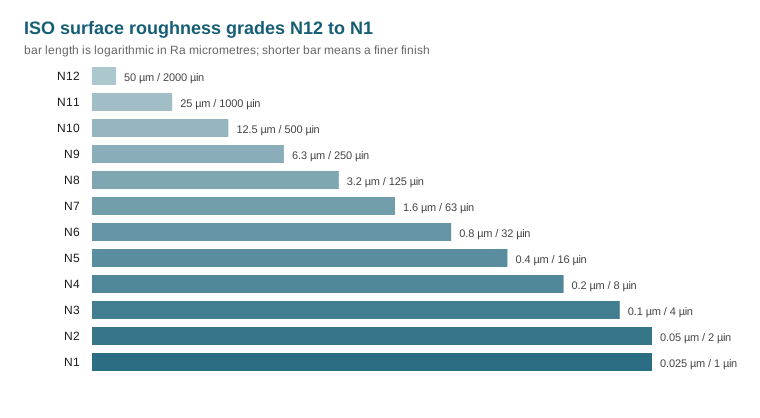
| ISO grade | Ra (µm) | Ra (µin) | RMS (µin) | CLA (µin) | Rt (µm) |
|---|---|---|---|---|---|
| N12 | 50 | 2000 | 2200 | 2000 | 200 |
| N11 | 25 | 1000 | 1100 | 1000 | 100 |
| N10 | 12.5 | 500 | 550 | 500 | 50 |
| N9 | 6.3 | 250 | 275 | 250 | 25 |
| N8 | 3.2 | 125 | 137.5 | 125 | 13 |
| N7 | 1.6 | 63 | 69.3 | 63 | 8 |
| N6 | 0.8 | 32 | 35.2 | 32 | 4 |
| N5 | 0.4 | 16 | 17.6 | 16 | 2 |
| N4 | 0.2 | 8 | 8.8 | 8 | 1.2 |
| N3 | 0.1 | 4 | 4.4 | 4 | 0.8 |
| N2 | 0.05 | 2 | 2.2 | 2 | 0.5 |
| N1 | 0.025 | 1 | 1.1 | 1 | 0.3 |
Common questions
What does N8 surface finish mean?
N8 is Ra 3.2 micrometres, or 125 microinches. The equivalent RMS reading is 137.5 microinch and the CLA figure is 125 microinch. Grades run from N12 (roughest, Ra 50) down to N1 (finest, Ra 0.025).
What does N7 surface finish mean?
N7 is Ra 1.6 micrometres, or 63 microinches. The equivalent RMS reading is 69.3 microinch and the CLA figure is 63 microinch. Grades run from N12 (roughest, Ra 50) down to N1 (finest, Ra 0.025).
What does N5 surface finish mean?
N5 is Ra 0.4 micrometres, or 16 microinches. The equivalent RMS reading is 17.6 microinch and the CLA figure is 16 microinch. Grades run from N12 (roughest, Ra 50) down to N1 (finest, Ra 0.025).
This page is an archival note for informational purposes only. It does not offer representation, evaluate claims, or create a professional relationship.