Plastic Gear Molding
Overview
Preserved shop record for b2b-plastic-injection.com. The former plant is not quoting from this domain. Target topic: plastic gear molding. The preserved pages of this shop speak in a narrow, practical language. Spro Tech Enterprise Co., Ltd. described itself as a professional mold maker and mold master, majoring in plastic injection molding, double plastic injection mold, die casting mold, and gas assistant plastic mould research. The company profile listed product families for auto part, electronic and computer, consumer electronic, and motorcycle part. The auto part page carried a long inventory of molded pieces: back mirror, consul set, big consul, computer cover, consul bodies and part, consul covers and part, automotive parts under consul, cover, electronic back, filler, and filter cover. That is the vocabulary of a shop that thinks in molds, cavities, cores, runners, and finished
Details
parts rather than in abstract manufacturing phrases. Plastic gear molding belongs inside that same process language. A plastic gear is not a single molded shape. It is a family of shapes that share a common duty: transmit motion, carry load, and hold center distance. In the preserved shop language, a gear begins as a mold design. The mold maker decides the parting line, the number of cavities, the gate location, the ejection strategy, and the cooling layout. For a gear, those decisions are not general. The tooth form, the hub, the web, the rim, and the bore all sit on the same part. The mold must fill the tooth spaces without trapping air, cool the rim and hub at rates that do not warp the pitch, and eject the part without nicking a tooth flank. The shop's phrase "high-precision plastic injection mold product and mold making design" fits here, because a gear is a high-precision product even when it is small. The preserved pages mention double plastic injection mold. That process language matters for gears. A two-shot or double injection mold can combine a rigid gear body with a softer hub, or a structural core with a wear-resistant tooth surface. The shop also listed gas assistant plastic mould research. Gas assist is not a gear-making default, but it belongs in the same tool room vocabulary when a thick hub or a heavy web needs internal packing without sink. The former plant did not quote from this domain, so the record stays at the level of process description: mold making, injection molding, double injection, die casting, and gas assist. For plastic gear molding, the material choice is part of the process language. The preserved pages do not name resins, and this record will not invent them. What can be said is that the shop's product list already includes covers, bodies, fillers, and filters. Those parts demand dimensional stability, surface finish, and repeatable cycle times. A gear demands the same, with the added condition that the tooth profile must repeat from cavity to cavity and from shot to shot. The mold maker's job is to hold that repetition. The molder's job is to hold the cycle. The two are not separate. Gate location affects shrinkage. Shrinkage affects tooth thickness. Tooth thickness affects backlash. Backlash affects how the gear runs against its mate. In the preserved shop language, this is all "mold making design" and "plastic injection molding." The auto part page is useful because it shows the shop's habit of listing molded parts by function: consul bodies, consul covers, computer cover, filter cover, electronic back. A gear would sit in that list as a functional molded part, not as a catalog curiosity. The same tool room that made a consul body or a filter cover can make a gear mold, provided the gear's geometry is respected. That means the mold design must account for the gear's own features: the tooth count, the pressure angle, the helix angle if any, the face width, the hub diameter, the bore, the keyway or flat, and the web thickness. Each of those features changes the fill pattern and the cooling pattern. A spur gear with a thin web cools differently from a helical gear with a solid rim. A small pinion with a metal insert cools differently from a plain molded gear. The preserved pages do not describe these variants, but they do describe the shop's range: auto, electronic, computer, consumer electronic, motorcycle. Gears appear in all of those fields. The former plant is not quoting from this domain. That means this record is not an offer, not a lead, and not a request for quotation. It is a preserved shop record. The process language stays inside what the pages show: mold maker, mold master, plastic injection molding, double plastic injection mold, die casting mold, gas assistant plastic mould research, high-precision plastic injection mold product, mold making design, automobile accessories, household accessories, computer accessories, and high-precision products. Plastic gear molding, read through that language, is a mold-making problem first and a molding problem second. The gear's teeth are the visible result. The mold's parting line, gate, cooling, and ejection are the hidden cause. The shop's own phrase, "committed to quality and leadership," is the only standard the preserved pages offer. For a gear, that standard is measured in tooth form, concentricity, and repeatability. The record ends where the preserved pages end. No prices, no forms, no addresses, no phone numbers, no URLs, no certifications. Just the shop's process language applied to plastic gear molding: mold design, injection, double injection, gas assist, high precision, and the molded part itself.
Surface finish reference
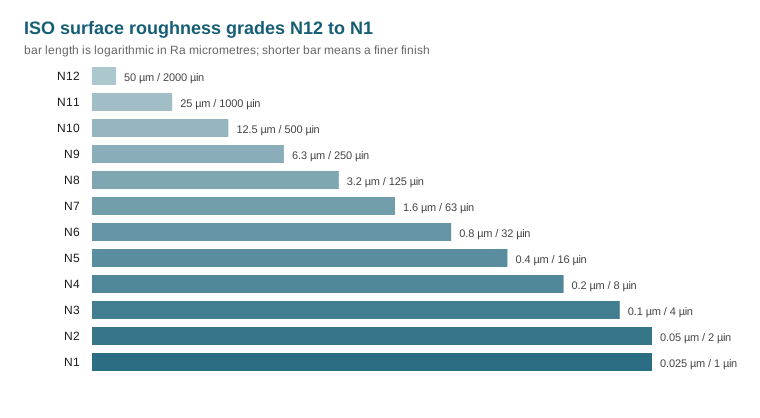
| ISO grade | Ra (µm) | Ra (µin) | RMS (µin) | CLA (µin) | Rt (µm) |
|---|---|---|---|---|---|
| N12 | 50 | 2000 | 2200 | 2000 | 200 |
| N11 | 25 | 1000 | 1100 | 1000 | 100 |
| N10 | 12.5 | 500 | 550 | 500 | 50 |
| N9 | 6.3 | 250 | 275 | 250 | 25 |
| N8 | 3.2 | 125 | 137.5 | 125 | 13 |
| N7 | 1.6 | 63 | 69.3 | 63 | 8 |
| N6 | 0.8 | 32 | 35.2 | 32 | 4 |
| N5 | 0.4 | 16 | 17.6 | 16 | 2 |
| N4 | 0.2 | 8 | 8.8 | 8 | 1.2 |
| N3 | 0.1 | 4 | 4.4 | 4 | 0.8 |
| N2 | 0.05 | 2 | 2.2 | 2 | 0.5 |
| N1 | 0.025 | 1 | 1.1 | 1 | 0.3 |
Common questions
What does N8 surface finish mean?
N8 is Ra 3.2 micrometres, or 125 microinches. The equivalent RMS reading is 137.5 microinch and the CLA figure is 125 microinch. Grades run from N12 (roughest, Ra 50) down to N1 (finest, Ra 0.025).
What does N7 surface finish mean?
N7 is Ra 1.6 micrometres, or 63 microinches. The equivalent RMS reading is 69.3 microinch and the CLA figure is 63 microinch. Grades run from N12 (roughest, Ra 50) down to N1 (finest, Ra 0.025).
What does N5 surface finish mean?
N5 is Ra 0.4 micrometres, or 16 microinches. The equivalent RMS reading is 17.6 microinch and the CLA figure is 16 microinch. Grades run from N12 (roughest, Ra 50) down to N1 (finest, Ra 0.025).
This page is an archival note for informational purposes only. It does not offer representation, evaluate claims, or create a professional relationship.