Multi-Cavity Injection Mold
Overview
Preserved Shop Record: b2b-plastic-injection.com The preserved pages of b2b-plastic-injection.com carry the record of Spro Tech Enterprise Co., Ltd., a mold maker and injection molding shop whose public catalog was organized around mold making, plastic injection molding, double plastic injection mold, die casting mold, and gas assistant plastic mould research. The site described the shop as an extensive experienced mold maker, majoring in plastic injection molding and related mold work for better quality and accommodation of environmental protection. Its product pages were grouped by application: molding for auto part, molding for electronic and computer, molding for consumer electronic, and molding for motorcycle part. The auto part page listed items such as AB Piller, Back Mirror, Consul Set, Big Consul, Computer Cover, Consul Bodies And Part, Consul Covers And Part, Automotive Parts
Details
(Consul), Automotive Parts (Cover), Automotive Parts (Electronic Back), Automotive Parts (Filler), and Filter Cover. Those names are the shop's own process language. They point to a plant that thought in terms of molds, cavities, covers, bodies, fillers, and mirror and consul assemblies rather than in terms of retail products. The target topic is multi cavity injection mold. Within the preserved language of this shop, a multi cavity injection mold belongs to the same family as the double plastic injection mold and the high-precision plastic injection mold named on the home page. The shop did not present itself as a seller of standard parts. It presented itself as a mold maker and mold master, with research and development listed alongside company profile, product, and contact pages. That framing matters for multi cavity work because a multi cavity mold is not simply a mold with more holes cut into it. It is a mold making decision that begins with the part family, the application, the plastic, the machine, the cooling layout, the runner and gate plan, the ejection plan, and the dimensional relationships between cavities. In the preserved product language, the auto part page shows a range of molded forms: covers, bodies, fillers, filters, mirror parts, and consul parts. A multi cavity injection mold for such parts would be organized around the common features of the part family. If the shop were building a mold for a cover, the cavity layout would follow the cover's perimeter, wall thickness, mounting points, and cosmetic surfaces. If the shop were building a mold for a filler or filter cover, the layout would follow the part's fit and sealing surfaces. If the shop were building a mold for a consul body or consul cover, the layout would follow the part's internal ribs, bosses, snap features, and visible faces. The preserved pages do not give dimensions or process sheets, but they do give the categories. Those categories are enough to describe how a multi cavity mold is approached inside this shop's process language. The home page also names die casting mold and gas assistant plastic mould research. Those are separate branches, but they share the mold making discipline. A multi cavity injection mold sits in the plastic injection molding branch. The shop's stated focus on high-precision plastic injection mold product and mold making design for numerous manufacturing fields, including automobile accessories, household accessories, computer accessories, and other high-precision products, places multi cavity work inside a broader mold making practice. The same mold master thinking applies whether the cavities are for an automotive cover, a computer cover, a household accessory, or a motorcycle part. A multi cavity injection mold is usually described by cavity count, but the shop's preserved language suggests that cavity count is only one line in the mold record. The more important lines are part application, mold construction, plastic injection molding behavior, and the relationship between the mold and the press. The preserved pages list product categories rather than machine tonnages or cycle times, so the record stays at the level of mold making and application. That is consistent with a shop that calls itself a mold maker and mold master. The mold is the product. The molded parts are the evidence. For a multi cavity mold, the runner system is a central concern. A balanced runner helps fill all cavities under similar conditions. An unbalanced runner can cause short shots, weld line shifts, or dimensional differences from cavity to cavity. The gate location affects fill pattern, packing, and cosmetic appearance. In a multi cavity mold for visible parts such as a back mirror or a consul cover, gate marks and flow lines must be placed where they will not spoil the visible surface. In a multi cavity mold for a filler or filter cover, the gate and ejection plan must protect the fit and sealing surfaces. These are not separate from the shop's process language. They are the practical meaning of high-precision plastic injection mold work. Cooling is another central concern. A multi cavity mold has more steel, more water lines, and more heat to remove. The cooling layout must reach each cavity evenly. If one cavity runs hotter than another, the parts will differ. In a mold for automotive parts, that difference can show up as warpage, sink, or a poor fit. In a mold for computer or consumer electronic parts, it can show up as a dimensional shift or a surface defect. The preserved pages do not list cooling details, but the shop's emphasis on quality and leadership, and its stated commitment to customer final satisfaction, places cooling and dimensional control inside the mold making responsibility. Ejection is also part of the multi cavity plan. More cavities mean more parts to remove per cycle. The ejector pins, sleeves, stripper plates, and lifters must be arranged so that each part leaves the mold without distortion. For a consul body with ribs and bosses, ejection points must be placed on strong features. For a cover with a thin wall, ejection must be spread to avoid marking or bending. The preserved product names do not describe these details, but they identify the part types that would drive them. The preserved record also shows a shop organized around research and development. That matters for multi cavity molds because cavity layout is often developed alongside the part design. A mold maker who is involved early can suggest wall thickness changes, draft, radii, and feature placement that make a multi cavity mold more stable. The shop's home page lists R & D as a main section, and the product pages list R & D alongside company profile, product, contact, and site map. That structure suggests that mold making and part development were not treated as separate transactions. The preserved pages do not quote from this domain now. They remain a record of how Spro Tech Enterprise Co., Ltd. described its mold making and plastic injection molding work. For the topic of multi cavity injection mold, the record gives a clear frame: the mold is made by a mold maker and mold master; the work is high precision; the applications include auto, electronic, computer, consumer electronic, and motorcycle parts; the related mold types include double plastic injection mold, die casting mold, and gas assistant plastic mould research. A multi cavity injection mold fits inside that frame as a plastic injection mold built for repeatable production of a part family, with cavity layout, runner and gate design, cooling, ejection, and dimensional control all treated as part of the mold making craft. The preserved product names, from AB Piller and Back Mirror to Consul Set, Big Consul, Computer Cover, Consul Bodies And Part, Consul Covers And Part, Automotive Parts (Consul), Automotive Parts (Cover), Automotive Parts (Electronic Back), Automotive Parts (Filler), and Filter Cover, show the range of molded forms that such a mold would serve. That is the shop record. It is written in the language of molds, cavities, covers, bodies, fillers, and applications, and it stays there.
Surface finish reference
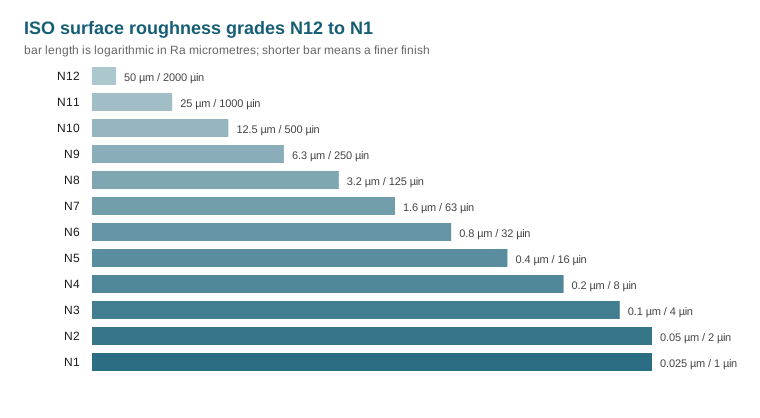
| ISO grade | Ra (µm) | Ra (µin) | RMS (µin) | CLA (µin) | Rt (µm) |
|---|---|---|---|---|---|
| N12 | 50 | 2000 | 2200 | 2000 | 200 |
| N11 | 25 | 1000 | 1100 | 1000 | 100 |
| N10 | 12.5 | 500 | 550 | 500 | 50 |
| N9 | 6.3 | 250 | 275 | 250 | 25 |
| N8 | 3.2 | 125 | 137.5 | 125 | 13 |
| N7 | 1.6 | 63 | 69.3 | 63 | 8 |
| N6 | 0.8 | 32 | 35.2 | 32 | 4 |
| N5 | 0.4 | 16 | 17.6 | 16 | 2 |
| N4 | 0.2 | 8 | 8.8 | 8 | 1.2 |
| N3 | 0.1 | 4 | 4.4 | 4 | 0.8 |
| N2 | 0.05 | 2 | 2.2 | 2 | 0.5 |
| N1 | 0.025 | 1 | 1.1 | 1 | 0.3 |
Common questions
What does N8 surface finish mean?
N8 is Ra 3.2 micrometres, or 125 microinches. The equivalent RMS reading is 137.5 microinch and the CLA figure is 125 microinch. Grades run from N12 (roughest, Ra 50) down to N1 (finest, Ra 0.025).
What does N7 surface finish mean?
N7 is Ra 1.6 micrometres, or 63 microinches. The equivalent RMS reading is 69.3 microinch and the CLA figure is 63 microinch. Grades run from N12 (roughest, Ra 50) down to N1 (finest, Ra 0.025).
What does N5 surface finish mean?
N5 is Ra 0.4 micrometres, or 16 microinches. The equivalent RMS reading is 17.6 microinch and the CLA figure is 16 microinch. Grades run from N12 (roughest, Ra 50) down to N1 (finest, Ra 0.025).
This page is an archival note for informational purposes only. It does not offer representation, evaluate claims, or create a professional relationship.